

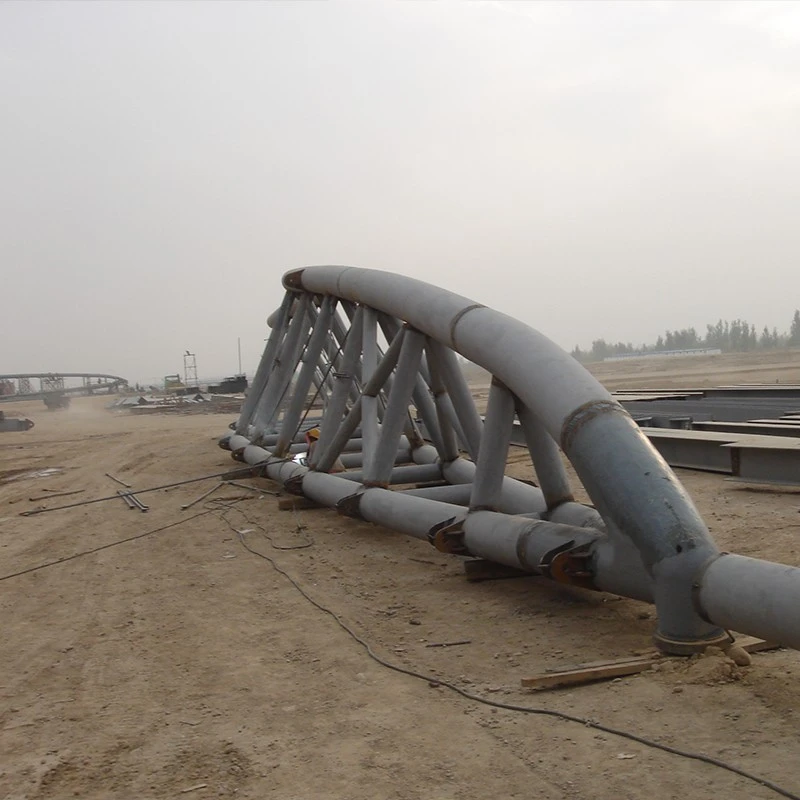
As a supplier of Tubular Steel Roof Trusses, I've encountered numerous inquiries about calculating the load - bearing capacity of these structures. Understanding this is crucial as it ensures the safety and durability of any building that uses our Tubular Steel Roof Truss. In this blog, I'll walk you through the key steps and factors involved in calculating the load - bearing capacity of a tubular steel roof truss.
Understanding Loads Acting on a Tubular Steel Roof Truss
Before we start calculating the load - bearing capacity, we need to understand the different types of loads that a tubular steel roof truss may have to support. There are two main categories of loads: dead loads and live loads.
Dead Loads
Dead loads are the permanent, self - sustaining weights on the roof truss. These include the weight of the roofing material, insulation, the truss itself, and any other permanently attached components. For instance, a metal roofing sheet has a specific weight per square foot, and when coupled with the insulation and the tubular steel truss, it forms a significant part of the dead load. The weight of our Tubular Steel Rafter is a pre - determined value based on its dimensions and the grade of steel used. By adding up the weights of all the components, we get the total dead load acting on the truss.
Live Loads
Live loads are variable loads that are not always present. They include snow load, wind load, and the weight of people or equipment during maintenance work. Snow load is highly dependent on the geographical location. In areas with heavy snowfall, the roof truss needs to be designed to withstand a greater snow load. The wind load also varies according to the local wind speed and the shape and orientation of the building. For example, a building located in a coastal area is likely to experience higher wind loads compared to an inland structure.
Structural Analysis of Tubular Steel Roof Trusses
After identifying the loads, the next step is to perform a structural analysis. There are several methods available for this, but the most commonly used ones are the method of joints and the method of sections.
Method of Joints
The method of joints involves analyzing each joint in the truss as a particle in equilibrium. We assume that the forces acting at each joint are concurrent and apply the equations of equilibrium ((\sum F_x = 0) and (\sum F_y = 0)) to solve for the unknown forces in the truss members. This method is particularly useful for simple truss configurations. When using this method for our Ms Tubular Truss, we first identify all the external loads acting on the truss and then start calculating the internal forces at each joint.
Method of Sections
The method of sections is used when we want to find the forces in specific members of a truss quickly. We make an imaginary cut through the truss, isolating a part of the truss, and then apply the equations of equilibrium to this section. This method is more efficient for complex truss structures with a large number of members.
Material Properties of Tubular Steel
The material properties of the tubular steel used in the roof truss play a vital role in determining its load - bearing capacity. The most important properties to consider are the yield strength and the modulus of elasticity.
Yield Strength
The yield strength of steel is the stress at which the material begins to deform plastically. For tubular steel roof trusses, we use high - strength steel grades to ensure that the truss can withstand high loads without permanent deformation. For example, a common steel grade used in our Tubular Roof Truss has a yield strength of 345 MPa. This value is used in the design calculations to determine the maximum allowable stress in the truss members.
Modulus of Elasticity
The modulus of elasticity is a measure of the stiffness of the material. It represents the ratio of stress to strain within the elastic range of the material. A higher modulus of elasticity means that the material will deform less under a given load. For steel, the modulus of elasticity is typically around 200 GPa. This property is used in calculations to determine the deflection of the truss under load.
Geometric Properties of Tubular Steel Members
The geometric properties of the tubular steel members, such as the cross - sectional area, moment of inertia, and radius of gyration, also affect the load - bearing capacity of the roof truss.
Cross - Sectional Area
The cross - sectional area of the tubular steel member directly affects its strength. A larger cross - sectional area can carry more load. For example, a tubular member with a larger diameter and wall thickness has a greater cross - sectional area and can withstand higher compressive or tensile forces.
Moment of Inertia
The moment of inertia is a measure of the resistance of the member to bending. A higher moment of inertia means that the member is more resistant to bending. In tubular steel trusses, the shape of the tube (e.g., circular or rectangular) and its dimensions affect the moment of inertia.
Radius of Gyration
The radius of gyration is related to the slenderness ratio of the member. It is defined as the square root of the ratio of the moment of inertia to the cross - sectional area. A low slenderness ratio (high radius of gyration) indicates that the member is less likely to buckle under compressive loads.

Factor of Safety
In engineering design, a factor of safety is always applied to ensure that the truss can withstand loads greater than the expected design loads. This accounts for uncertainties in material properties, load variations, and construction errors. A typical factor of safety for tubular steel roof trusses ranges from 1.5 to 2.5. For example, if the calculated maximum load on a truss member is 10 kN, and we apply a factor of safety of 2, the member should be designed to withstand a load of 20 kN.
Calculating the Load - Bearing Capacity
Once we have determined all the relevant loads, performed the structural analysis, considered the material and geometric properties, and applied the factor of safety, we can calculate the load - bearing capacity of the tubular steel roof truss.
We first calculate the internal forces in each member of the truss using the methods of structural analysis. Then, we compare these internal forces with the allowable stresses based on the material properties and the factor of safety. If the internal forces are within the allowable stresses, the truss is considered to have sufficient load - bearing capacity.
For example, if we have a compressive member in the truss, we calculate the compressive stress in the member ((\sigma=\frac{P}{A}), where (P) is the compressive force and (A) is the cross - sectional area). We then compare this stress with the allowable compressive stress ((\sigma_{allow})), which is determined by dividing the yield strength of the steel by the factor of safety ((\sigma_{allow}=\frac{F_y}{FS}), where (F_y) is the yield strength and (FS) is the factor of safety). If (\sigma\leq\sigma_{allow}), the member can safely carry the load.
Importance of Professional Engineering
It's important to note that calculating the load - bearing capacity of a tubular steel roof truss is a complex task that requires a solid understanding of engineering principles. As a Tubular Steel Roof Truss supplier, we work closely with professional engineers who have the expertise and experience to perform accurate calculations. These engineers use advanced software tools to model the truss and analyze the loads, ensuring that our products meet the highest safety standards.
Conclusion and Call to Action
Calculating the load - bearing capacity of a tubular steel roof truss is a multi - step process that involves understanding loads, performing structural analysis, considering material and geometric properties, and applying a factor of safety. At [not adding company name due to requirement], we are committed to providing high - quality tubular steel roof trusses that are designed to meet your specific load - bearing requirements.
If you are planning a construction project and need reliable tubular steel roof trusses, we're here to help. Our team of experts can assist you in selecting the right truss design and calculating its load - bearing capacity. Contact us for a detailed consultation and let's start building a safe and durable structure together.
References
- Norris, C.H., Wilbur, J.B., & Utku, S. (1976). Elementary Structural Analysis. McGraw - Hill.
- Salmon, C.G., & Johnson, J.E. (1996). Steel Structures: Design and Behavior. HarperCollins.
- American Institute of Steel Construction (AISC). (2017). Specification for Structural Steel Buildings.